Assessed Value vs. Market Value

Last updated: October 2026
Quick Answer: Assessed value is BC Assessment's estimate of your property's value as of July 1 of the previous year, used to calculate property taxes. Market value is what a buyer would realistically pay today. The 2026 assessments reflect July 1, 2025 values, and prices have fallen since, so many Vancouver assessments now sit above current market value.
Here's what most people get wrong: they treat their BC Assessment notice as a price tag. It isn't. It's a tax tool, built on data that was already six months old the day the notice arrived in your mailbox, and more than a year old by now.
That gap matters more in 2026 than it has in years. For most of the last decade, Vancouver homes regularly sold well above their assessed values, so sellers learned to treat the assessment as a floor. Today, with prices still easing, that habit can lead a seller to overprice and a buyer to overpay.
Let me break down what each number actually measures, where they're diverging right now, and which one should guide your decisions.
What is assessed value?
Assessed value is the figure BC Assessment, a provincial Crown corporation, assigns to every property in British Columbia each year. Its main job is to divide up the property tax bill fairly across the province.
For the 2026 assessment roll, BC Assessment valued properties based on market conditions as of July 1, 2025, and their physical condition as of October 31, 2025. Those notices were mailed in early January 2026.
Assessments are produced using mass appraisal. Rather than visiting every home, BC Assessment uses sales data, property records, and statistical models to value large groups of similar properties at once. That's efficient for more than two million properties, but it means the model can miss what makes your specific home different.
Key factors that influence assessed value include:
- Location and neighbourhood
- Lot size and zoning
- Home size, age, and general condition as recorded in BC Assessment's files
- Comparable sales around the valuation date
Your notice also splits the total into land and improvements (the buildings). In Vancouver, land typically makes up most of a detached home's assessed value, which is why an older house on a large lot can carry a very high assessment.
What is assessed value used for?
Assessed value feeds into several things beyond your annual property tax bill:
- Municipal property taxes, calculated by applying your city's tax rate to your assessed value
- The BC Home Owner Grant, which phases out above a threshold set each year. For 2026, that threshold dropped to $2.075 million, down from $2.175 million, the first decline since 2020
- Vacancy-related taxes such as Vancouver's Empty Homes Tax and the provincial Speculation and Vacancy Tax, which are calculated using assessed value
What it is not used for: setting a sale price, or determining the property transfer tax you pay when you buy. Property transfer tax is based on fair market value, which is usually the purchase price.
What did the 2026 BC Assessments show for Vancouver?
The 2026 roll showed values falling across most of the region, the first broad decline in several years.
According to BC Assessment's January 2026 release:
- City of Vancouver detached homes: typical assessed value fell from $2,205,000 to $2,092,000, down 5%
- City of Vancouver strata homes (condos and townhomes): typical value fell from $798,000 to $772,000, down 3%
- Across the Lower Mainland, most changes ranged between -10% and 0%
- Total Lower Mainland assessed value dropped from roughly $2.01 trillion to about $1.92 trillion
What is market value?
Market value is the price a home would realistically sell for on the open market today, between a willing buyer and a willing seller, with neither under pressure to act.
Unlike assessed value, market value responds in real time to everything happening in the market:
- Recent sales of truly comparable homes nearby
- Current supply and demand, including how many similar homes are competing for the same buyers
- Condition, layout, and updates that a mass-appraisal model may not capture
- Location details like a quiet street, a view, or a busy arterial road
- Interest rates and buyer confidence
- Buyer and seller motivation
This is the number that matters when you're buying or selling. It's what buyers are willing to pay and sellers are willing to accept today.

How far apart are assessed and market values in Vancouver right now?
For many properties, assessed value is now likely higher than market value. That's the reverse of what most Vancouver owners got used to over the past decade.
The reason is timing. The 2026 assessments captured values as of July 2025, and prices have kept easing since. According to Greater Vancouver REALTORS® data for September 2026:
Sales were down 8.4% year-over-year, and the overall sales-to-active-listings ratio was 10.9%, with detached homes at 9.7%. GVR generally considers a ratio below 12% sustained over several months a sign of downward pressure on prices.
In 2026, your assessment is a snapshot of a market that no longer exists. If prices in your segment have kept falling, your assessed value may now be the ceiling, not the floor.
That doesn't apply to every home. A renovated property, a rare lot, or a home in a high-demand pocket can still sell above its assessment. The point is that you can't assume either direction anymore. You have to check.
What does the gap look like in practice?
Here are two hypothetical examples to show how far the two numbers can drift.
Scenario 1: The market moved, the assessment didn't. An East Vancouver detached home is assessed at $1.9 million as of July 2025. By fall 2026, detached prices in the area have eased further and there's more competition from similar listings. A comparative market analysis points to a realistic sale price around $1.78 million. The owner who lists at $1.95 million "because that's what BC Assessment says" is likely to sit on the market, take price reductions, and end up selling for less than if they'd priced accurately from day one.
Scenario 2: The home changed, the assessment didn't. A Burnaby townhome is assessed at $950,000. Since the assessment, the owners finished the basement and fully renovated the kitchen and bathrooms. BC Assessment may not have those updates on file yet. Comparable renovated units nearby support a value closer to $1.04 million, so the market value is above the assessment despite a softer overall market.
Same principle in both cases: the assessment reflects a past date and recorded data. The market reflects today and the actual home.
If you're trying to figure out which side of that gap your property sits on, that's exactly what a proper market analysis is for.
How is assessed value different from an appraisal?
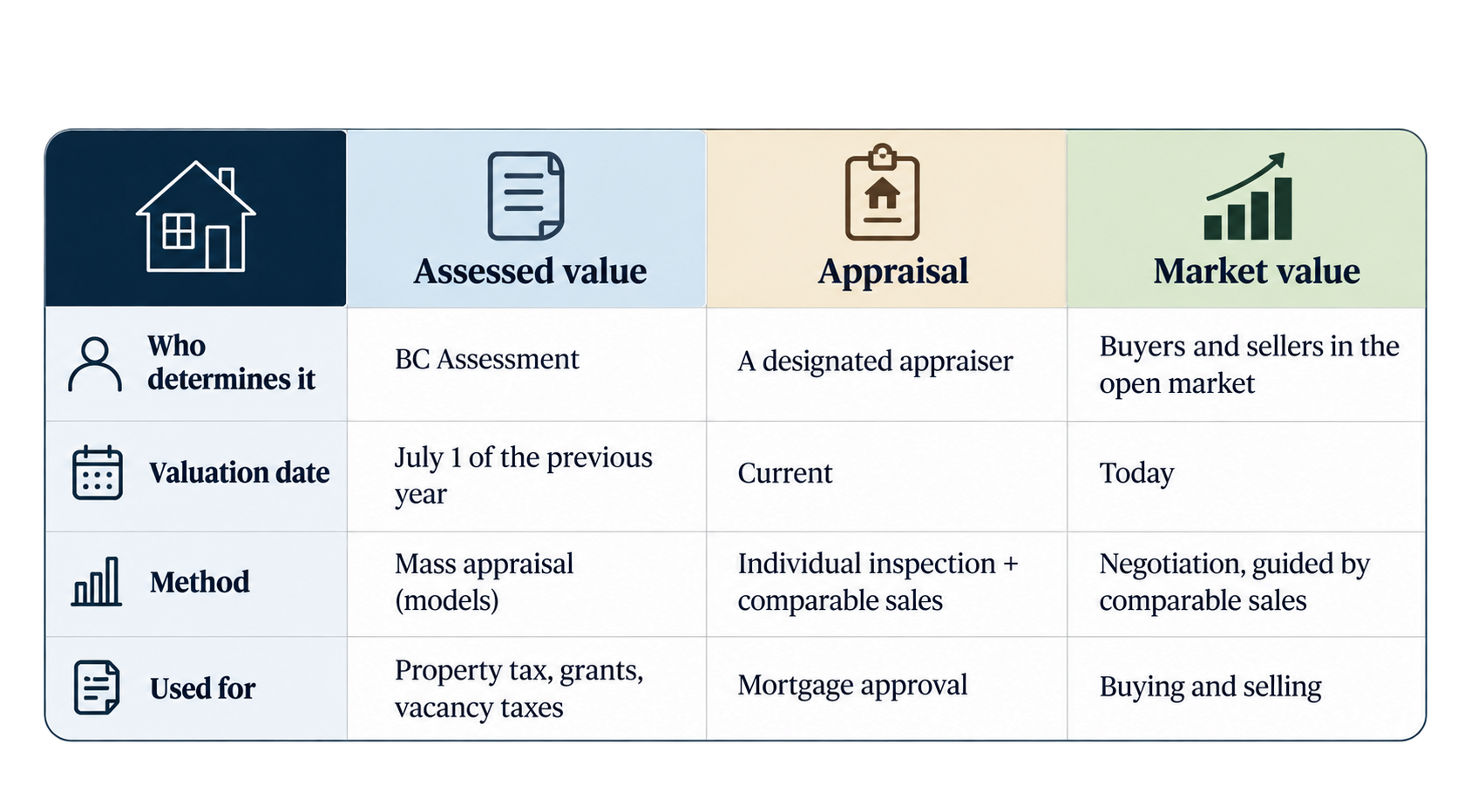
A lender's appraisal is the closest formal estimate to market value, because it's current and specific to the property. If you're buying with a mortgage, the appraisal, not the assessment, determines how much your lender will lend. I go into that in detail in How Real Estate Appraisals Work in Canada.
Which value should you trust when buying or selling?
If you're buying, selling, or investing, focus on market value. Assessed value tells you what you'll pay in property tax. It doesn't tell you what a home is worth today.
For sellers: Don't price off your assessment. In 2026, that could mean overpricing in a market where buyers have choice and time. A comparative market analysis (CMA) uses the most recent comparable sales, current competing listings, and your home's actual condition to recommend a price that will attract real offers.
For buyers: Don't treat a list price below assessed value as an automatic bargain. In a declining market, the assessment may simply be out of date. Look at what comparable homes have sold for in the last 60 to 90 days, not what they were assessed at last year.
For owners who aren't selling: If you believe your assessment is too high relative to July 1, 2025 market conditions, you can contact BC Assessment. For the 2026 roll, the deadline to file a formal Notice of Complaint was February 2, 2026, so any concern now would apply to next year's notice, which arrives in early January 2027 and will reflect values as of July 1, 2026.
Frequently Asked Questions
Q: Why is my BC Assessment higher than what homes are selling for?
A: Your 2026 assessment reflects market value as of July 1, 2025. Since then, Greater Vancouver's composite benchmark price has fallen 5.5% year-over-year to $1,075,900 as of September 2026, so many assessments now sit above current market prices.
Q: How much did Vancouver assessments change in 2026?
A: In the City of Vancouver, typical detached assessments fell 5% to $2,092,000, and typical strata assessments fell 3% to $772,000. Across the Lower Mainland, most changes ranged from -10% to 0%, according to BC Assessment.
Q: Does a lower assessment mean lower property taxes?
A: Not necessarily. Your tax depends on how your assessment changed relative to the average change in your municipality, and on your city's budget and tax rate. If your value fell less than average, your taxes could still rise.
Q: Can I appeal my BC Assessment?
A: Yes. Start by contacting BC Assessment to review your file. If you still disagree, you can file a Notice of Complaint by the annual deadline, which was February 2 for the 2026 roll. The next notices arrive in early January 2027.
Q: Should I list my home at its assessed value?
A: No. Assessed value is set for tax purposes using July 1 data from the previous year. With detached benchmark prices down 7.3% year-over-year as of September 2026, pricing off your assessment could leave your home overpriced and sitting on the market.
Your assessment and your home's market value were never meant to be the same number. One is a tax snapshot from last summer. The other is what a real buyer will pay this week. For years, the gap ran in sellers' favour, and people stopped paying attention to it. In 2026, the gap can run the other way, and the owners and buyers who check the real numbers before they act are the ones who avoid an expensive surprise.
If you want a straight read on where your specific property or purchase fits into this, that's the conversation I have with clients every week.
About Richard: Richard is a Vancouver REALTOR® with Vancouver House Sales, specializing in helping first-time buyers, growing families, and downsizers navigate Vancouver's real estate market with clarity and confidence. He takes a strategy-first, education-focused approach to every client relationship.