How to Sell a Home in a Slow Vancouver Market in 2026: The 7 Things That Actually Move Price

Quick Answer: In Vancouver's current buyer's market sales running 26.6% below the 10-year average, 16,917 active listings, and benchmark prices down 6–8% year-over-year selling still works if you follow the right sequence. Pricing correctly from day one, presentation, and negotiation posture matter more than at any point in the last decade. These seven factors are what actually separate a sold sign from a stale listing.
Most sellers in a slow market make the same mistake: they treat every tool as equal. Stage it. Price it. Post it. Hope.
That's not a strategy. In Vancouver's June 2026 market where detached homes carry a sales-to-active ratio of just 10.7% and apartments are sitting an average of 50+ days before going conditional the sellers who close at a number they can live with are working a specific order of operations. Three of these seven factors will move your price more than the other four combined. I'll tell you which ones.
1. Price Accuracy on Day One Is the Whole Game
This is the one that eclipses everything else. Not "price it a bit high and come down." Not "test the market."
In Vancouver's current conditions, homes priced above comparable sales even by 5% are sitting for months. Rain City Properties' April 2026 market snapshot put it plainly: "The market is punishing overpricing more harshly than I've seen since 2012–2013." Well-priced homes in desirable neighbourhoods are still selling in 2–4 weeks. Overpriced ones are hitting 3–6 months.
Here's what most people get wrong about this: buyers aren't starting from your list price. They're starting from the comps their agent pulled that morning. If your list price doesn't match those comps, your home doesn't make their shortlist it makes their "wait and see" list. And in a market with 16,917 active listings (34.6% above the 10-year seasonal average, per Greater Vancouver Realtors May 2026 statistics), the buyer has plenty of alternatives while they wait.
The number to understand: GVR's own historical data shows sustained downward price pressure sets in when the sales-to-active ratio falls below 12%. The detached segment hit 10.7% in May 2026. That means pricing defensively isn't optional it's table stakes.
What this looks like in practice: Pull every comparable sale within the last 60 days, not 90. In a declining market, 90-day comps will price you above where the market actually is today. Focus on the bottom of the comp range, not the middle. That's your ceiling, not your floor.
2. The Listing Window You Choose Matters More Than the Calendar Says
Spring listing season exists. So does the myth that it's always your best option.
In 2026 Vancouver, the real listing window question isn't "spring vs. fall" it's "how many competing properties are on the market the week I go live?" New listings in Metro Vancouver dropped 7.6% year-over-year in May 2026, per GVR's latest statistics. That sounds bad for buyers, but for a seller it means less direct competition in individual sub-markets.
Watch your immediate neighbourhood's inventory, not the Metro-wide number. A townhouse in Mount Pleasant competes against other Mount Pleasant townhouses in the same price band. If six similar units are already listed on your street, wait two weeks. If inventory is thin in your category, move.
The other timing factor is days on market accumulation. Buyers and their agents watch how long a listing has been active. Once you cross 30 days without conditional offers, your property signals that something is wrong even if nothing is. Buyers start discounting the price in their head before they even book a showing. Launching at the right moment protects you from that clock starting at the wrong time.
3. Photography and Video: The Filter Before the Front Door
Every buyer in 2026 eliminates homes before visiting them. Your listing photos aren't marketing they're the screening process.
According to the National Association of Realtors' 2025 Profile of Home Staging, listings with professional photography receive 118% more online views. In a market where buyers are patient and have 16,000+ active listings to scroll through, that view-count difference determines whether you get showings or silence.
This isn't the place to cut costs. A professional real estate photographer costs 300–300–600 in Metro Vancouver. A listing that sits an extra month costs you mortgage carrying costs, strata fees, property tax, and the negotiating leverage you lose as days on market climbs. The math is not close.
Twilight photography, drone footage for lots with views or multiplex potential, and a short walk-through video are worth adding if your property has any of these features. Bill 44's rezoning has made lot characteristics increasingly searchable buyers looking for R1-1 development potential are filtering specifically for this.
4. Staging: The Three Rooms That Do the Work
Professional staging is not about making your home look like a hotel. It's about making the buyer's imagination do the job your square footage can't.
Canadian data consistently shows staged homes sell faster: staged properties in Canada average 25 days on market compared to 184 days for unstaged ones, according to industry data cited by North Shore Realty. That gap is extreme, but even the conservative end of the research 49% of sellers' agents report staging reduced time on market, per NAR's 2025 survey represents a meaningful advantage in a market where time is your enemy.
The rooms that actually move buyers: living room first, primary bedroom second, kitchen third. Everything else is secondary. You don't need to stage the entire property focus the budget on those three spaces.
The renovation trap: Don't spend $40,000 on a kitchen renovation before listing. In Vancouver's 2026 buyer's market composite benchmark down 6.9% year-over-year full kitchen tear-outs, pool installations, and highly personalized design choices are 30–60% ROI projects at best, per [Rain City Properties' pre-sale renovation analysis](https://raincityproperties.com/journal/best-renovations-before-selling-vancouver-home-2026-roi). The high-ROI moves are paint, decluttering, kitchen refresh (not replacement), bathroom refresh, landscaping, lighting, and hardware. Spend $5,000–$15,000 on those before spending $50,000 on anything structural.
The sellers who close at a number they can live with in this market are the ones who price correctly from day one, present well, and negotiate from a position of strategy not desperation.
5. Offer Evaluation: What You're Actually Measuring
This is where I see sellers leave the most money on the table.
In a slow market, you're not just evaluating the number. You're evaluating the probability of this deal closing. A higher offer that collapses at subject removal because the buyer's financing doesn't hold puts you back on market with a stigmatized listing and more days on the clock. A lower, clean offer from a qualified buyer might net you more in the end.
Richard's Two-Variable Offer Framework:
When I sit down with sellers to review offers, we score on two axes:
- Net proceeds not the gross price, but what actually lands in your bank account after adjusting for closing date, inclusions, and any seller-paid concessions
- Closing probability deposit size, financing conditions, buyer pre-approval quality, number of conditions, and subject removal timeline
A $1.5M offer with a 2% deposit, 10 conditions, and 21 days of subjects from an unverified buyer is worth far less than a $1.45M offer with a 5% deposit, two standard conditions, and 7-day subject removal from a pre-approved buyer. The math only looks close until you factor in the probability of the first deal surviving subjects.
Conditional offers are back in Vancouver. Buyers are educated and patient. Treat a well-structured conditional offer from a qualified buyer as the win it is.
If you're trying to figure out whether your pricing and presentation strategy is calibrated for where the market actually is right now, that's exactly the kind of conversation I have with clients every week. Reach out and I'll give you an honest read on your property →
6. Negotiation Posture: The Market You're In Versus the Market You Remember
The market you sold into in 2021 is not the market you're selling into in 2026. This sounds obvious. It's apparently not.
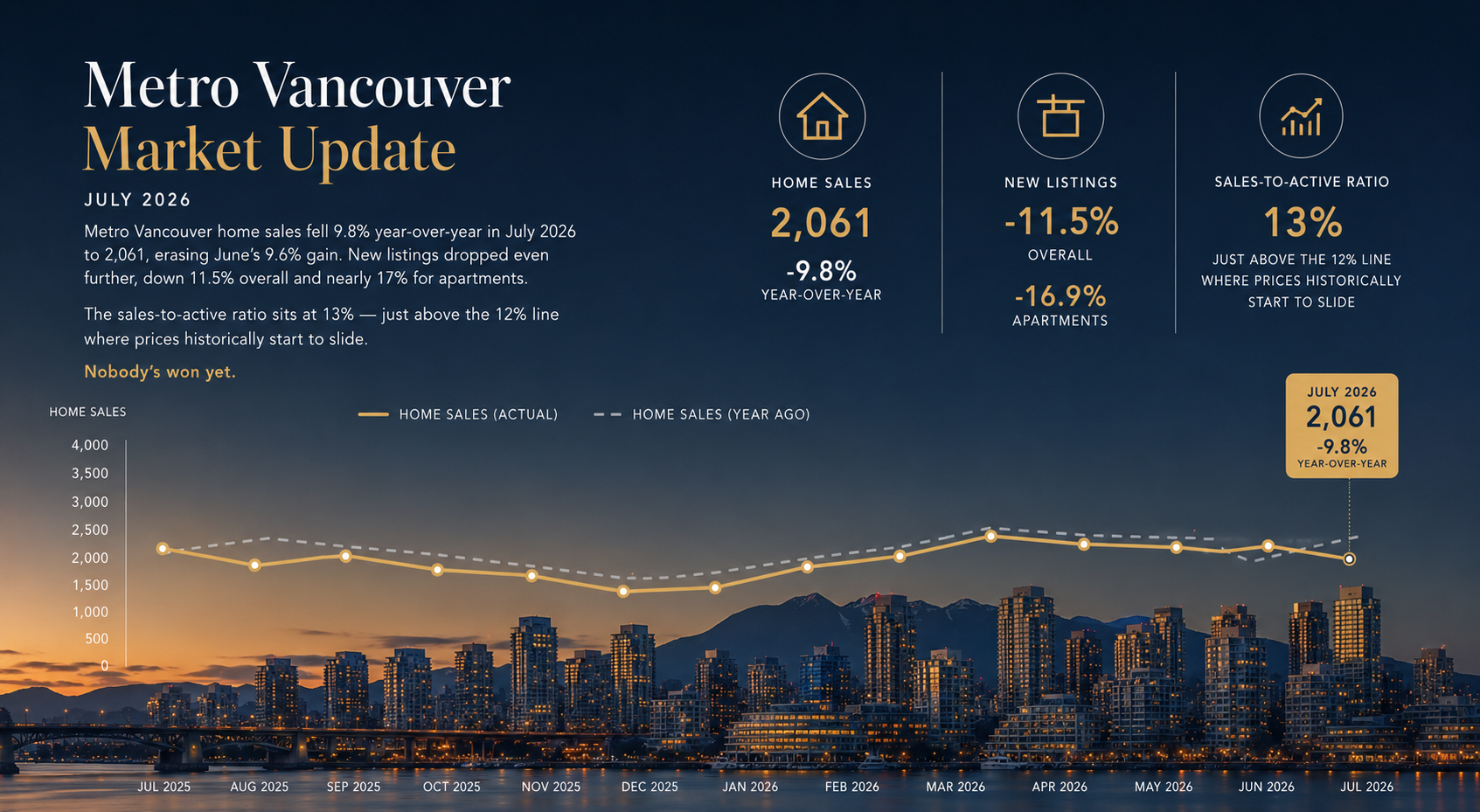
Metro Vancouver residential sales hit 2,150 in May 2026, down 3.5% year-over-year and 26.6% below the 10-year seasonal average, per GVR's June 2026 release. Bidding wars are rare. Conditions are back. Buyers are walking away from properties that don't pencil out. Sellers who negotiate from a 2021 posture "we won't budge, another offer is coming" are regularly ending up with neither offer.
The right negotiation posture in a buyer's market has a different shape. You hold firm on price if you're priced correctly. You're flexible on terms closing date, deposit structure, inclusions, completion timing because these cost you little but mean a lot to the right buyer. A buyer who needs a longer completion to align with their own sale closing is a motivated buyer. Work with it.
What you don't do: reduce price to "test" if a lower number generates activity. It usually doesn't, and it signals to every buyer watching your listing that you're in distress.
7. Exposure: Where Your Listing Lives (and Who Actually Sees It)
MLS is not enough in 2026. It's table stakes.
Buyers in Metro Vancouver are searching across multiple platforms before they ever contact an agent. Realtor.ca, Zolo, HouseSigma, and direct agent outreach are all in the buyer's research stack. Your listing needs to be findable, complete, and accurate on all of them. That means remarks written to the buyer reading them on a phone at 10pm, not to the agent skimming them in the morning.
For properties with specific buyer profiles multiplex potential lots, downsizer-friendly strata, family homes in school catchment areas targeted digital outreach to buyers who've already been searching in your category for 60+ days is one of the highest-leverage moves an agent can make in a slow market. The buyer who's been watching Kits detached homes for four months is not going to stumble on your listing by accident. You have to find them.
International buyer channels matter for the right properties too. The Bank of Canada held its policy rate at 2.25% on June 10, 2026, with five-year fixed rates settling in the 4.1–4.4% range at brokerages. That's meaningfully lower than the 5%+ rates buyers faced in 2022–2023, and it has brought some offshore capital back to the market particularly for properties in Richmond, West Vancouver, and the City of Vancouver. Your agent should know which buyer pools are actively looking in your segment.
What This Means for You
If you're a seller trying to decide whether to list now or wait, here's how I'd break it down by situation.
You're downsizing into a strata: This is one of the better environments to make this move in years. The price gap between your detached home and your target strata has compressed detached benchmarks are down 6.9% year-over-year, but your buying power on the purchase side benefits from the same conditions. The math is friendlier than it looks. The apartment segment at $697,800 benchmark still has room to negotiate.
You're a move-up buyer selling and buying simultaneously: Follow the sell-first or buy-first sequence that matches your financial cushion, not your preference. If you have strong equity and a flexible timeline, buying before selling can work but get a bridge financing commitment from your lender before you go conditional on a purchase. Don't assume it will be available when you need it.
You own a condo in a high-inventory building: Be realistic. Apartment sales fell 7.2% year-over-year in May 2026, and downtown, Yaletown, and parts of Burnaby are carrying heavy inventory in the 1-bedroom and studio categories. Two-bedroom units in family-friendly areas like Mount Pleasant and Kitsilano are performing materially better. Know which bucket you're in before you set price expectations.
You own a detached home with lot potential: The R1-1 rezoning under Bill 44 is still creating demand from builders, even as they negotiate harder than in 2024. A lot with clear multiplex potential marketed to both end-user buyers and builder buyers is reaching a wider pool. Price it for the end user, and let the builder competition create a ceiling.
Frequently Asked Questions
Q: How long is it taking to sell a home in Vancouver right now?
A: As of mid-2026, well-priced homes in desirable neighbourhoods are selling in 2–4 weeks. The Metro Vancouver average is now over 50 days, with overpriced or poorly presented properties sitting 3–6 months. The gap between correctly priced and overpriced is larger than at any point in the last decade.
Q: Should I drop my price if my Vancouver home isn't selling?
A: First establish whether the issue is price or presentation. If you've had showings but no offers, price is likely the problem. If you've had very few showings, presentation and marketing may be the issue. A price reduction without fixing the underlying problem rarely generates the activity sellers hope for and it tells the market you're motivated to sell below your original number.
Q: Is it worth staging a home in Vancouver's current market?
A: Yes, almost always. Staged homes in Canada average 25 days on market versus 184 for unstaged properties. In a market with 16,000+ active listings, staging is one of the clearest ways to move your listing out of the pile. Budget for the living room, primary bedroom, and kitchen as your three priority spaces.
Q: How much have Vancouver home prices dropped in 2026?
A: According to Greater Vancouver Realtors' May 2026 statistics, benchmark prices are down 6.9% year-over-year for detached homes ($1,847,900), 7.9% for apartments ($697,800), and 5.1% for townhouses ($1,048,200). Month-over-month, prices have been largely flat the sharp declines of 2024 and early 2025 have slowed.
Q: Is now a bad time to sell in Vancouver?
A: "Bad time" depends on what you're selling and why. For sellers who need to move life changes, mortgage renewal pressure, upsizing waiting for a better market is a gamble with your timeline. A well-executed sale in today's market will net you less than 2021, but the conditions on the buy side are equally different. The move-up math often works in your favour.
Q: What renovations should I do before selling my Vancouver home?
A: In the current market, high-ROI pre-sale work is: fresh paint (entire interior, neutral tones), deep cleaning, decluttering, kitchen hardware and fixtures refresh, bathroom refresh (not replacement), and landscaping. Full kitchen tear-outs and additions are 30–60% ROI projects in 2026 you'll spend more than you recover on the sale price.
Q: Do I need an offer review date in a slow market?
A: In most cases, no. Offer review dates (holding offers) work when you're expecting multiple competitive offers. In today's market, setting a review date and receiving one offer or none signals weakness. Price correctly, present well, and review offers as they come. Keep your negotiating leverage intact.
Vancouver's 2026 market rewards sellers who go in with clear eyes. The tools that worked in 2021 price high, hold firm, wait for the frenzy will cost you time, money, and stress in a market with 16,917 active listings and a sales-to-active ratio of 13.1%. The seven factors above are what I work through with every seller I take on. Three of them pricing accuracy, offer evaluation, and negotiation posture will determine 80% of your outcome.
If you want to talk through your specific property, the segment it sits in, and what a realistic outcome looks like in this market, book a 20-minute call and I'll give you the straight answer →.
About Richard Richard is a Vancouver REALTOR® specializing in helping growing families, downsizers, and move-up sellers navigate Metro Vancouver's real estate market with clarity and strategy. He takes an education-first, pressure-free approach to every client relationship.
Sources: Greater Vancouver Realtors May 2026 Monthly Statistics Report (June 2, 2026); WOWA.ca Vancouver Housing Market Update (June 3, 2026); Rain City Properties April 2026 Market Snapshot; Rain City Properties Pre-Sale Renovation ROI Analysis (May 2026); National Association of Realtors 2025 Profile of Home Staging; Bank of Canada Rate Announcement (June 10, 2026); NerdWallet Canada Mortgage Rate Update (June 2026); RBC My Money Matters BoC Rate Update (June 10, 2026).