Why Is Housing Inventory Rising in Vancouver in 2026?

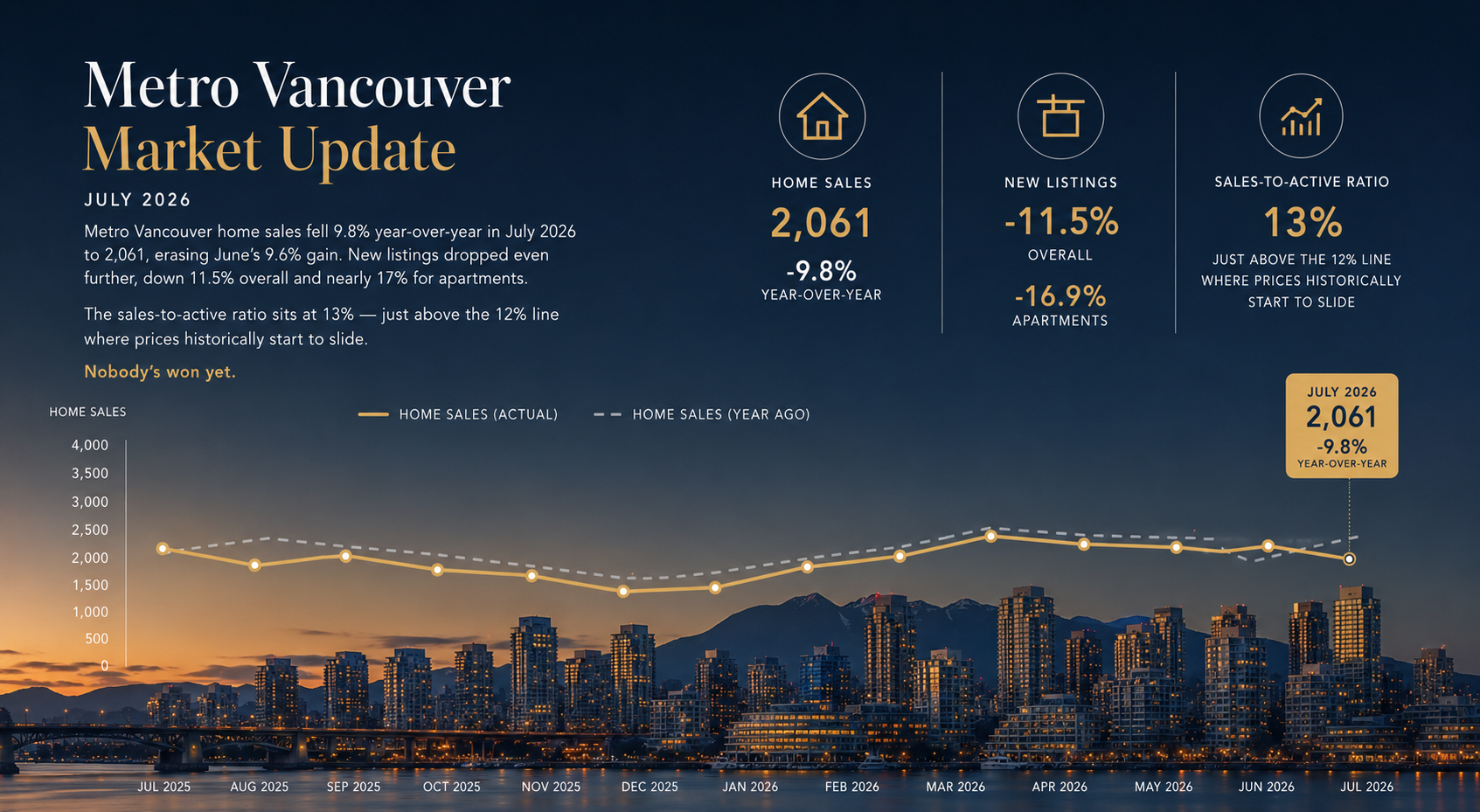
Quick Answer: Metro Vancouver inventory climbed to 17,017 active listings by June 2026, 30.2% above the 10-year seasonal average. Three forces drove it: presale completions hitting the resale market, sellers who waited out 2023–2025 finally listing, and demand recovering slower than supply. New listings fell 6% year-over-year in June, an early signal the buildup may be topping out.
Inventory didn't rise in Vancouver because buyers disappeared. It rose because sellers came back faster than buyers did. That's the part most market updates skip, and it's the difference between reading this moment correctly and reading it backward.
By the end of June 2026, there were 17,017 active residential listings across Metro Vancouver, according to Greater Vancouver REALTORS® (GVR). That's 30.2% above the 10-year seasonal average for the month. At the same time, sales were up 9.6% year-over-year. Both things are true at once. That combination, more listings and more sales, is what actually explains the buildup. It isn't a one-directional weakness. It's a supply recovery that outran a demand recovery, for reasons that are specific and identifiable.
What do the current numbers actually show?
Inventory is elevated but has started to plateau, not accelerate. That distinction matters more than the headline number.
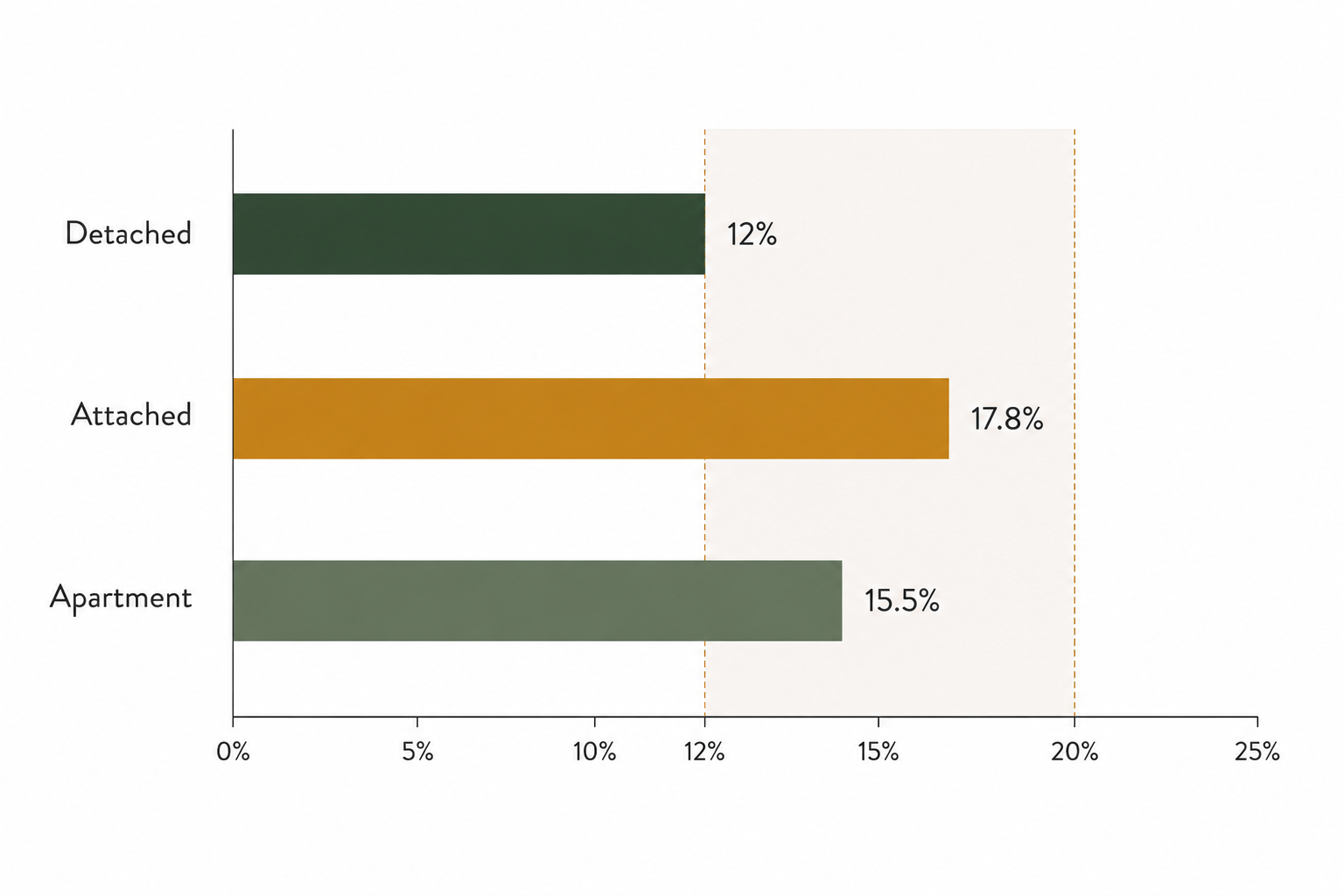
GVR reported 5,938 new listings hit the MLS® in June 2026, down roughly 6% from June 2025. Total active listings were also down 3.1% compared to a year earlier (17,561 in June 2025), even though they still sit far above the 10-year norm. The sales-to-active-listings ratio, the metric GVR's own economists use to call market direction, came in at 14.6% across all property types in June: 12% for detached homes, 17.8% for attached, and 15.5% for apartments.
GVR's chief economist, Andrew Lis, put it plainly in the June release: prices tend to fall when that ratio sits under 12% for a sustained stretch, and rise when it clears 20%. At 14.6%, Vancouver sits in the middle. Balanced, not collapsing.
Here's what most agents get wrong when they talk about this: they describe rising inventory as if it's still happening in real time. It isn't, not the way it was in 2024 and 2025. The stock of homes for sale is high. The rate of new supply arriving is now slowing. Those are different signals, and conflating them leads buyers to expect a discount that may not show up this fall.
The four forces that actually built this inventory wave
Most coverage of Vancouver's rising inventory points to "more listings" and stops there. That's not an explanation. It's a restatement of the number. Here's the actual mechanism, broken into the four forces I watch with clients.
Richard's Four Forces Behind the Inventory Wave:
- Presale completions arriving late. Projects launched in 2021 and 2022, during the last hot cycle, are completing now. Buyers who bought pre-construction three to four years ago are closing, and a meaningful share are listing immediately or assigning their contracts rather than moving in. This has hit the condo segment in Coquitlam, Burnaby South, and Richmond hardest, where some newer buildings are trading 8–12% below their 2022 peaks.
- Sidelined sellers finally acting. Between 2023 and 2025, thousands of Vancouver homeowners held off listing, waiting for rates to drop, waiting for prices to recover, waiting for "the right time." As borrowing costs stabilized through 2026, a lot of that pent-up supply hit the market at once. This isn't panic selling. It's delayed selling, arriving in a bunch.
- Demand recovering slower than supply. Sales in June 2026 were up nearly 10% year-over-year, which sounds strong. But they were still 12.4% below the 10-year seasonal average for June. Buyers are back, but cautiously, comparing listings, negotiating harder, and taking longer to commit than they did in 2021.
- Segment-specific absorption gaps. Not every part of the market is oversupplied the same way. Detached homes sit at a 12% sales-to-active ratio, right at the edge of downward price pressure. Attached and apartment segments, at 17.8% and 15.5%, are absorbing supply more efficiently. Lump the whole market together and you miss where the actual leverage is.
None of these four forces is permanent. Presale completions from the 2024–2025 launch slump mean there's a real supply gap coming in 2027–2028. Sidelined sellers are a one-time release, not an ongoing tap. That's part of why the June data already shows new listings cooling.
The number that matters here isn't the total listing count it's the sales-to-active ratio. Vancouver sits at 14.6% right now. Below 12%, prices come under real pressure. Above 20%, they climb. Right now, we're in the zone where the market is deciding which way it tips next.
Is inventory still rising, or has it started to turn?
It's leveling off, and the June data is the first real evidence of that shift.
Standing inventory was actually down 3.1% year-over-year by the end of June, even with the total still historically high. New listings fell 6% year-over-year in the same month. Put together, GVR's own economist flagged this directly: "with recent data revealing a slower pace of new listings coming to market, standing inventory is no longer climbing, and may be showing early signs of reversing."
That's not a forecast. That's what already happened in June. September typically brings a seasonal wave of new listings as families settle post-summer, so it's too early to call a firm trend but the direction changed before most of the market noticed.
If you're a buyer who's been waiting for inventory to peak before making a move, the window to act while supply is still elevated is probably measured in months, not years.
Thinking through what this actually means for your specific situation whether you're buying into this window or timing a sale around it is exactly the kind of conversation worth having before the fall market shifts again. [Book a 20-minute strategy call →]
What does rising inventory mean for buyers vs. sellers right now?
It depends entirely on which segment you're in, not on the headline market condition.
For buyers, elevated inventory means real negotiating room but unevenly distributed. Detached buyers, especially outside the west side and North Shore, are seeing the most flexibility: longer days on market, more price reductions, sellers accepting subject-to clauses again. Condo buyers in newer buildings with heavy presale completion think parts of Coquitlam, Burnaby, and Richmond are seeing the deepest discounts, sometimes 8–12% below 2022 pricing on assignment sales.
For sellers, the read is different by segment too. If you're selling a well-priced, well-presented home in a tight sub-segment (detached under $1.5M in East Van, for example), you're still transacting in reasonable time. If you're selling a newer-build condo competing against a wave of presale completions in the same building or block, you're pricing against your neighbours' assignment listings whether you like it or not.
- Detached sellers: price to the 12% ratio reality competitive, not aspirational.
- Attached/townhouse sellers: the 17.8% ratio gives you more room than the headlines suggest.
- Condo sellers in completion-heavy buildings: expect to compete directly with assignment sales, and price accordingly from day one.
- Buyers in any segment: the leverage is real right now, but it's shrinking as new listings slow this isn't a leverage window with an indefinite shelf life.
What this means for you
If you're a buyer who's been sitting on the sidelines, this is close to the best combination of inventory and price softness Vancouver has offered since before 2022 but the early signs of a turn mean the calculus changes by segment and by month, not by year.
If you're a seller in the detached segment, price is the lever that matters most right now. The ratio sitting at 12% means overpricing costs you weeks, not days.
If you own a newer condo in a building still absorbing presale completions, don't assume your unit is immune to what's happening two floors down. Assignment pricing sets the comp whether it's officially "sold" through MLS® or not.
And if you're trying to decide whether to buy now or wait for inventory to climb further it probably won't, not by much. The forces that built this wave are largely one-time events working their way through the system.
Frequently Asked Questions
Q: Is Vancouver a buyer's market right now? A: Not uniformly. The overall sales-to-active-listings ratio sits at 14.6%, which GVR classifies as balanced. Detached homes, at 12%, are closer to buyer's-market territory than attached or apartment segments.
Q: Why did so many condos hit the market at once in 2026? A: Presale projects launched during the 2021–2022 boom are completing now, and a meaningful share of those buyers are listing or assigning rather than moving in, concentrated in Coquitlam, Burnaby South, and Richmond.
Q: Will inventory keep rising through the rest of 2026? A: Unlikely at the same pace. New listings were down 6% year-over-year in June, and GVR's own data shows standing inventory may be leveling off, though a seasonal bump is normal in September.
Q: Does rising inventory mean prices will drop further? A: Only in segments where the sales-to-active ratio stays under 12% for a sustained period. As of June 2026, that's specifically the detached segment, not the whole market.
Q: Is now a good time to buy in Vancouver? A: It depends on your segment and timeline, not the headline inventory number. Buyers targeting condos in completion-heavy buildings or detached homes outside prime pockets have the most leverage today.
Q: How does the Bank of Canada's rate decision affect Vancouver inventory? A: The BoC held its overnight rate at 2.25% on July 15, 2026, its sixth consecutive hold. Stable rates have encouraged both the sidelined sellers and cautious buyers now active in the market, which is part of why supply and demand are both up at once.
Q: What's the difference between active listings and months of inventory? A: Active listings is the raw count of homes for sale. Months of inventory estimates how long it would take to sell that stock at the current sales pace a more useful number for judging real balance than the headline listing count alone.
Vancouver's inventory story in 2026 isn't a simple "too much supply" narrative, and it isn't a simple "still a seller's market" one either. It's four specific forces working through the system at different speeds, in different segments. Reading the headline number without reading the segment underneath it is how buyers overpay for leverage that isn't there, and how sellers underprice a home that didn't need the discount.
If you want a straight read on where your specific property or purchase fits into this, that's the conversation I have with clients every week. [Reach out for a no-pressure, complimentary, strategy call →]
About Richard Richard is a Vancouver REALTOR® with Vancouver House Sales, specializing in helping first-time buyers, growing families, and downsizers navigate Vancouver's real estate market with clarity and confidence. He takes a strategy-first, education-focused approach to every client relationship. [Learn more] | [Book a call]
Sources: Greater Vancouver REALTORS® June 2026 Monthly Market Report (published July 3, 2026); Bank of Canada, Monetary Policy Report and interest rate announcement, July 15, 2026; Business in Vancouver, "Vancouver multi-family sector enters a market correction," July 2026.